
Some destinations teach you things that no classroom quite manages. Not because the classroom is wrong, but because certain lessons only land when you’re standing inside the thing you’ve been studying. The proportions of a building. The way afternoon light behaves at a particular latitude. The relationship between a whitewashed wall and a cobalt blue sky. These are the kinds of lessons Mykonos delivers.
The Greek island is famous for parties and sunsets and celebrity sightings, and all of that is real enough. But underneath the tourist layer sits something much older and more interesting: a built environment refined over centuries by people who had no formal training but an extraordinarily developed sense of place, proportion, and material. For artists, designers, and architecture students, that environment is worth studying seriously.
Here are eight reasons Mykonos belongs on the creative traveler’s list.
1. The Cycladic Architecture Is a Masterclass in Restraint
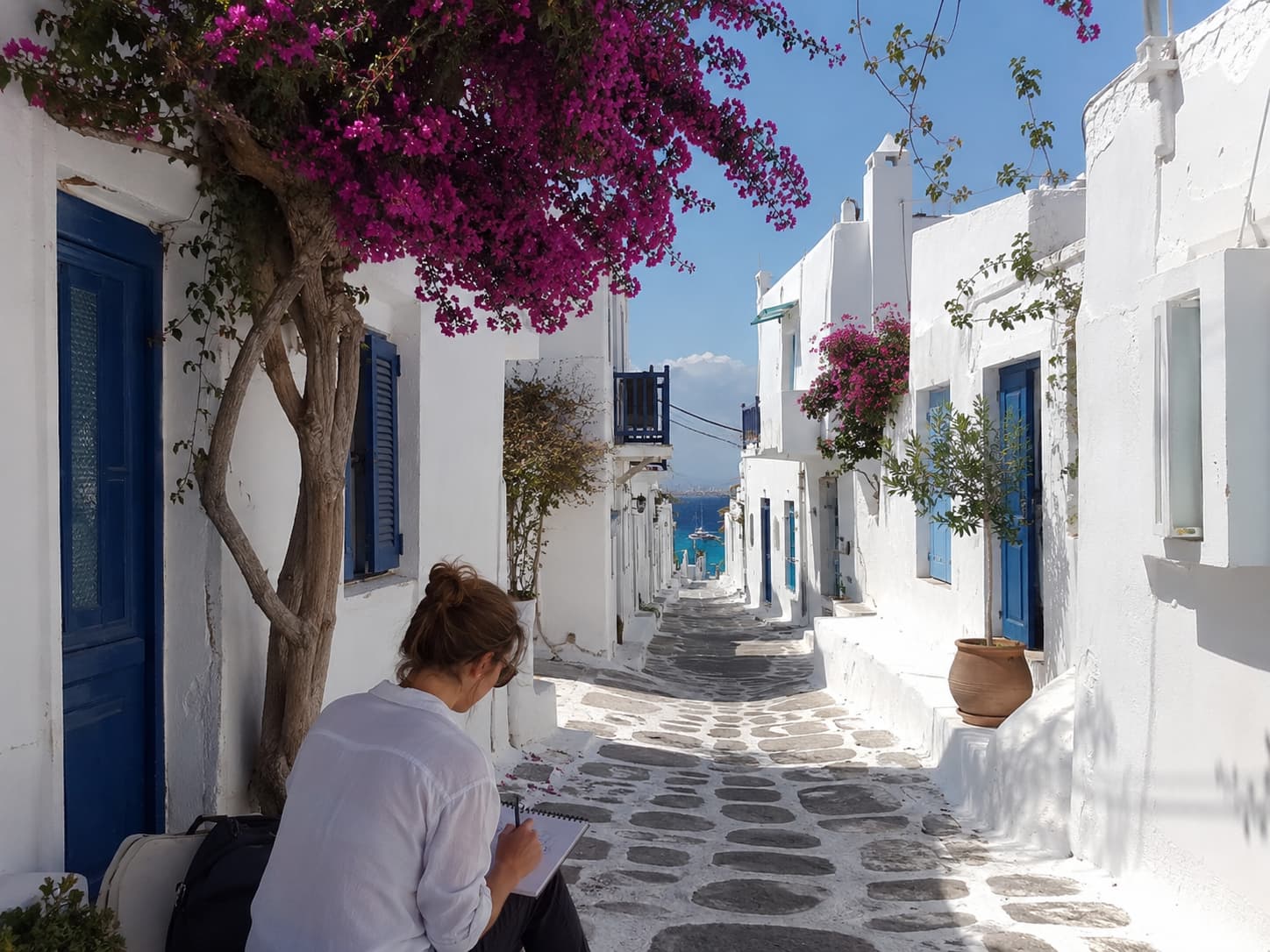
Cycladic architecture, the style native to Mykonos and the surrounding islands, operates on a logic almost opposite to most Western architectural traditions. Where European academic architecture tends toward symmetry, decoration, and hierarchical composition, Cycladic building is additive, irregular, and almost entirely without ornament. Whitewashed cubic volumes stack and connect organically, following the slope of the hillside rather than imposing a geometric order on it.
The result looks simple. It isn’t. The apparent simplicity is the product of centuries of iterative refinement, where every unnecessary element was stripped away until what remained was exactly what the building needed to be. Architecture students who have studied modernism will recognize the underlying principles immediately, because modernist designers like Le Corbusier studied Cycladic vernacular architecture directly and drew from it heavily. Seeing the original source is a different experience from reading about it.
2. The Light Is Unlike Anywhere Else in Europe
Painters talk about Greek light the way photographers talk about golden hour: as something qualitatively different from the light you experience at home. At this latitude, the angle of the sun, the clarity of the air, and the reflective surfaces of the whitewashed buildings combine to produce a brightness that changes colour perception in ways that are hard to anticipate.
Shadows are harder and more defined. Blues are deeper. The transition between sunlit surface and shadow is more abrupt than in northern climates. Artists who work with colour, whether in painting, textile, ceramics, or digital media, tend to come back from Mykonos with a recalibrated sense of what colour can do. The experience is difficult to replicate in a studio, and impossible to replicate from a photograph. You need to be there, ideally in the middle part of the day when the light is at its most extreme, to understand what the painters were responding to.
3. The Street Layout Is a Study in Organic Urban Design
Mykonos Town, known locally as Chora, was deliberately designed to confuse. The narrow, winding lanes that radiate unpredictably from the waterfront were laid out to disorient pirates approaching from the sea, making it impossible to move quickly through the town in a straight line. The result, centuries later, is an urban environment that has no equivalent in planned cities.
Every corner opens onto a surprise: a courtyard, a chapel, a sudden view of the sea between two walls. The scale shifts constantly. Wide enough for two people to pass, then narrow enough that you have to turn sideways. Architecture students interested in the relationship between urban form and human movement could spend days here and not exhaust the material. The town is a working example of how constraints, in this case topography, defence, and building materials, produce spatial richness that no amount of intentional design could have generated from scratch.
4. Mykonos Has a Long Relationship With Working Artists
The island attracted a significant community of painters, sculptors, and writers from the mid-twentieth century onward, drawn by the same light and landscape that makes it compelling now. The Aegean Maritime Museum in Chora holds a collection of local art alongside its navigation exhibits. Small galleries operate in the old town throughout the season, showing work that ranges from tourist-grade reproductions to genuinely interesting contemporary work from Greek and international artists who have made the island a seasonal base.
For art students thinking about how place shapes creative output, Mykonos offers something instructive: a landscape that has been painted, photographed, and depicted so many times that the challenge of finding a fresh response to it is itself an exercise worth undertaking. What do you do with a subject that has been thoroughly exhausted? How do you look at something everyone has already looked at and find something new? These are questions worth sitting with.
5. The Windmills Are an Argument for Functional Beauty
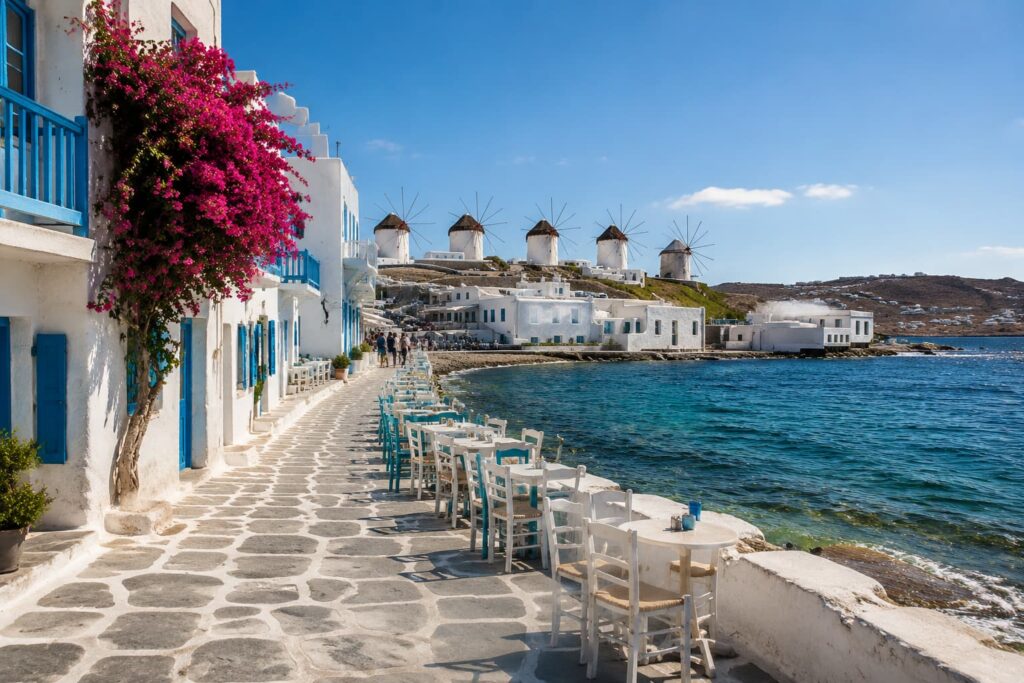
The seven surviving windmills on the Kato Mili ridge above Mykonos Town are among the most photographed structures on the island, and there’s a reason they keep appearing in images: they are exceptionally well-designed objects. Built by Venetians in the 16th century to mill grain from the Aegean trade routes, they are functional structures with no decorative ambition whatsoever. And yet they’re beautiful.
The thatched conical caps, the tapered cylindrical towers, the relationship between the solid mass of the base and the delicate radiating arms: every element is there because it needs to be, and the result is a form that holds up visually from every angle and at every distance. For design students interested in the relationship between function and aesthetics, the windmills are a useful counter-argument to the idea that ornament is what makes something visually interesting. These structures have no ornament. They don’t need any.
6. A Guided Tour Provides the Historical Context That Makes Everything Click
Mykonos is easy to visit independently, but without some understanding of the island’s history, a lot of what you’re looking at remains surface. The specific reasons why the town was built the way it was, the role of the island in Aegean trade networks, the influence of successive Venetian, Ottoman, and Greek governance on the built environment: these layers aren’t visible unless someone points them out.
Operators like Mykonos Tours offer guided experiences that move through the architectural and cultural history of the island, connecting the physical environment to the social and economic forces that shaped it. For anyone with a background in art history or architectural training, that kind of context transforms what might otherwise be a pleasant walk through a pretty town into something genuinely educational. The details start to mean things they didn’t before.
7. The Island’s Craft Traditions Are Worth Seeking Out
Behind the designer boutiques and high-end restaurants, Mykonos has a craft heritage rooted in the same conditions that shaped its architecture: limited materials, practical necessity, and a highly developed aesthetic sense born of working within constraints. Traditional weaving, embroidery, and ceramics all have roots on the island, though they require some effort to find now.
The local approach to craft, particularly in textiles, shares something with the approach to architecture: a preference for geometric pattern, a restrained palette based on what natural dyes and local materials produced, and a compositional logic that values repetition and rhythm over complexity. Students of art education who have studied the relationship between material constraint and visual style will find Mykonian craft a useful live example. Just as formal training shapes the work of a painter or sculptor, the constraints of island life shaped these traditions in ways that are still visible in the surviving examples.
Our coverage of art and design education touches on how formal training develops visual literacy: the ability to read a made object and understand the decisions behind it. Mykonos rewards that kind of literacy at every turn, in its buildings as much as in its craft objects.
8. Little Venice Shows What Happens When Builders Trust the Setting
The neighbourhood called Little Venice, a row of 18th-century houses built directly on the waterfront with their balconies cantilevered over the Aegean, is one of the more photographed spots on the island. The name is slightly misleading, the resemblance to Venice is superficial, but the underlying architectural logic is fascinating.
These houses were built by sea captains, and the overhanging balconies face directly west, toward the prevailing winds and the setting sun. The builders placed themselves as close to the sea as physically possible, trusting the landscape to do what a garden wall or a painting would do in a northern European house: frame and contain the world outside. The result is a relationship between interior space and exterior environment that very few architectural traditions manage so directly.
For students studying how architecture responds to landscape, Little Venice is a simple and clear example of what happens when designers trust the setting rather than trying to compete with it. That lesson translates across scales, from building design down to the kind of decisions that shape drawing and composition training: what to include, what to leave out, and when the context is already doing the work for you.
A Final Thought
Travel has always been part of how artists develop. The Grand Tour that shaped European painters and architects for centuries was built on the idea that seeing the real thing, the actual building, the actual landscape, the actual light, does something that study alone cannot. Mykonos isn’t Rome or Florence, but it offers something those cities don’t: a built environment produced without academic training, by people solving real problems with available materials, and arriving at something that professional architects and designers have been studying ever since.
Go with a sketchbook if you can. Walk the back streets of Chora in the early morning before the crowds arrive. Sit in front of one of the windmills and spend an hour just looking at it. The island will teach you things about proportion, light, restraint, and the relationship between form and place that are hard to find anywhere else.
That’s worth the trip on its own.